This article examines the aerodynamic phenomenon of the ground effect and its influence on the performance and overtaking dynamics of Formula 1 (F1) cars. This analysis examines how F1 teams enhance cornering speed by utilizing airflow behavior near the ground to generate additional downforce. Ground effect emerges from accelerated airflow beneath the car, creating a low-pressure region that “sucks” the vehicle downward, enabling faster and more stable turns. The paper outlines key aerodynamic components –including front wings, diffusers, and rear wings–as well as various experimental and computational research methods –such as computational fluid dynamics, wind-tunnel testing, and track validation. Ground effect has undeniably improved lap times and vehicle stability; however, its impact on overtaking remains contested, with studies showing mixed correlations between downforce regulations and passing frequency. Ultimately, ground effect represents a critical intersection of physics and engineering that continues to shape modern F1 car design.
Introduction
As a part of the Viterbi GlobalXP Fall Lead Program, I explored Sydney, Australia, and went go-karting with some friends. My recent fascination with motorsports piqued my interest in karting, so I sped off to win races and felt the rush as I sped past my friends. It was so fun, in fact, that I raced again in New Zealand a week later, this time against strangers. My expectations were the same: to zoom past everyone and snatch first place. Among my three races, I finished 11th, 12th, and 10th. There were only 12 other people. Clearly, there was something wrong with the kart, not me!
In reality, I knew that there wasn’t any difference between my kart and everyone else’s. So how did the other drivers get past me? I searched through what separates the bad drivers from the good ones, and my mind naturally went to the best of the best: Formula One.
Often hailed as the pinnacle of motorsports, Formula One, or F1, is made up of 10 teams, each equipped with two drivers, racing cars at speeds of 370 kmph (230 mph) [1]. Each team designs its own vehicle under F1 regulations, often equipped with the most ground-breaking and innovative motorsport technology on the planet [1] [2]. Despite each team producing its own cars, drivers can finish a lap milliseconds apart from each other. That means teams must maximize every opportunity to improve their car, spending up to $215 million USD per year [3].
Of all the strategies and technologies that contribute to making faster cars, one area is vital: aerodynamics. Air’s interactions with a vehicle at low speeds are barely noticeable, but can become the deciding factor of a race at 300 kmph. By researching air flow on design prototypes, F1 engineers can make a car carve and slice through the air like a bullet. This research is what leads to the unique silhouettes distinct from any car you’d find on the freeway [2].
As fast as they are, F1 cars aren’t only designed to drive in a straight line. In reality, the corners and bends are what matter most for the shortest lap time [4]. Engineers are aware of this and capitalize on a physical phenomenon known as the ground effect. This effect revolutionized how F1 teams produce faster cars.
Ground Effect: What is it?
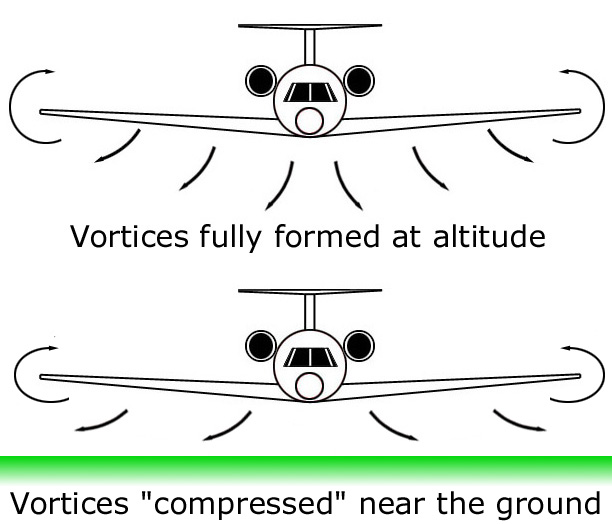
The ground effect was originally coined in the aviation industry, referring to the changes that an aircraft experiences as it approaches the ground. For example, a plane at high altitude is hit with airflow head-on and redirects some downward. But as an aircraft descends, the ground disrupts and “compresses” the downwards flow. This compression of airflow pushes the plane upward [4].

F1 cars, however, increase the force downwards rather than upwards [4] [5]. The silhouette of F1 cars mimics upside-down airplane wings. This design, paired with the car’s proximity to the ground at high speeds, squeezes the airflow between the wing and the ground, leading to faster air beneath the vehicle compared to above it. This difference in airflow speeds above and beneath the car changes air pressure and leads to a suctioning effect that sucks the car toward the ground, producing a downward force that scientists refer to as downforce. This ground effect operates on Bernoulli’s principle, which states that a fluid such as air increases speed at the same time as a drop in its pressure [4] – [6]. The increase in speed beneath the car decreases the pressure beneath it, producing the suctioning effect [4] – [6]. F1 engineers design cars with the ground effect in mind to combat inertia. Imagine you are turning right at a green light. As you turn, your body and the vehicle are fighting against a leftward push, a phenomenon known as inertia, as you turn right. Now imagine the same corner at 100 kmph. Your body would be thrown to the left, and the car would flip. F1 cars turn at these speeds without slowing down because the downforce generated by the ground effect sucks them to the ground, producing more grip and turn stability. The result is a car that turns corners at highway speeds rather than in school zones, drastically reducing the time needed to complete a lap [5] [6].
F1 is also not a competition to determine who can produce the most downforce. There is a major tradeoff with the ground effect. As downforce increases, so does air resistance, making it more challenging for a car to move in a straight line [2]. Finding the right balance between turning speed and straight-line speed is the principal challenge F1 engineers face when building the car [2].
Just as the effect differs across cars, it is not constant within the same car. As any vehicle slows down, the weight of the car is transferred forward due to inertia, shifting its weight onto the front tires and off the rear. The temporarily lowered front also lowers the front wings, bringing the wings closer to the floor and further squeezing the air into the tight space under the car. This enhances the ground effect as airflow is further constrained, creating an even greater difference in airflow [5]. The reverse can be said for when a car accelerates out of the corner: the weight is shifted onto the rear wheels, the front wings lift, and airflow under the vehicle slows down, weakening the suction of the car and its downforce [5]. Drivers must consider these minor fluctuations in height as they navigate corners, highlighting the sensitivity of the effect to the most minute of details [5].
Despite its nuances, every F1 team has implemented ground-effect strategies since the 1970s[7]. Each model, every year, is subject to rigorous testing through a variety of methods before hitting the track [6] to ensure only the most perfected versions make it on race day. To analyze every aspect possible of their prototypes, teams rely on computer and physical simulations, in addition to realistic test drives.
Research Methods & Tools for F1 Aerodynamics
The governing body of F1—the FIA, or Fédération Internationale de l’Automobile— mandates certain parts of every F1 car, including tires, safety equipment, and engine control systems [3]. The rest of the vehicle, such as the front wings, diffuser, undertray, and rear wings, must be designed by each team. To experiment with new designs, teams extensively research their aerodynamics, testing them through three main methods: computer fluid dynamics (CFD) simulations, wind tunnel testing, and full-scale track testing [6].

CFD simulations utilize advanced computer software to simulate the impact of air on a prototype design. These are often the first option in F1 aerodynamics research, given the minimal setup and equipment cost that it requires. Although computer simulation software has made significant advances in recent years, several forms of testing are done after to further perfect the car’s performance [6].
Full-scale track testing involves implementing prototypes on real closed circuits and monitoring the vehicle’s performance, simulating real race conditions [6]. This form of testing is the most expensive as it requires physical implementation and is often left as a final assessment for prototype models [6].
The most common method, however, is the use of wind tunnel tests. A moving belt rolls underneath the car, simulating the track road as air streams blow toward the car at race speeds [6]. Airflow directly hitting the car, however, could produce inaccurate airflow patterns since the ground drags on the air to a minor degree [6]. This causes a boundary layer, or a stream of unsteady “dirty air,” which skews aerodynamic data [6]. To fix this, a plate perforated from the ground is set a few feet ahead of the car to distribute the air evenly, while a suction section is set between the plate and the vehicle, removing any turbulent airflows from reaching the car and leaving “clean air” to hit the car [6].

Aerodynamic Components
As research tools have become increasingly advanced, so have the technologies they have enabled. Components such as the diffuser, front wings, and tires all contribute to the car’s aerodynamic efficiency and its ability to produce ground effect downforce.
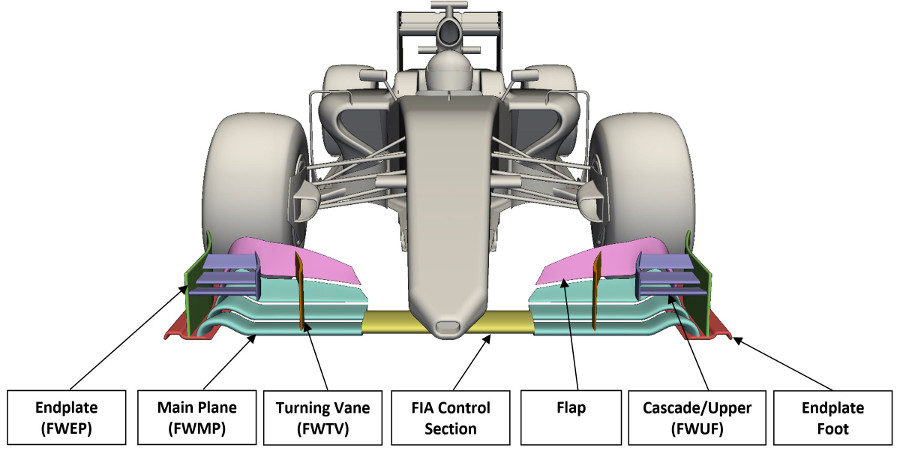
Since air flows from the front of the car to the back as it drives forward, the first notable parts of the vehicle to interact with incoming airflow are the front wings. These parts are symmetrical sheets of carbon fiber protruding from the left and right sides of the nose cone, as seen in Figure 4. The front wings feature customized curvatures and end plates on each side to tailor airflow (Figure 5). Many modern vehicles enhance this by designing “multi-element wings” that consist of multiple smaller wings, following the preceding pattern at a raised height. Front wings contribute approximately 25-30% of the total downforce generated by the car and regulate the aerodynamics of the rest of the vehicle since all components work in the wake of the front wings [6]. This includes the diffuser and the rear wings [6].
The diffuser controls the airflow underneath the car and towards the rear, magnifying the ground effect and contributing to downforce towards the rest of the vehicle. The diffuser is characterized by a small opening at the beginning, following its shape as it expands towards the end, similar to a funnel (Figure 5). The shape is designed to constrain airflow from the small opening of the diffuser and use the diffuser’s increasing size towards the end to slow down airflow [6] [8]. Repeating the ground effect, the faster stream at the opening produces a negative pressure and can contribute over half of the total downforce. However, its effectiveness is limited by the flow from the front wing [6] [8]. Both these components work together in addition to the rear wings, which act similarly to the front wings to help increase corner speeds and decrease lap times.

Ground Effect in Overtaking
A major component that makes F1 so enticing is seeing drivers pass one another, also known as overtaking. Though it has undoubtedly made F1 cars faster, there is no consensus on the ground effect’s influence on overtaking [9]. The ground effect’s contribution to overtaking is difficult to measure, as teams have constantly innovated for years to master the amount of downforce generated, thereby changing the use of ground effect every year. Additionally, the implementation of ground effect components overlaps with numerous other rule changes, it makes it incredibly difficult to isolate its effectiveness [8] [9]. Moreover, front wings and other downforce-generating components are also designed with ideal, freestream airflow in mind. These are not common conditions when competing, where nearby cars produce their own wakes, altering and disrupting the effectiveness of the ground effect [9].
Based on existing research, the ground effect downforce was reduced in the 1994-1995 season due to FIA regulations, resulting in 8% reduction in overtaking [9]. The following season, however, saw negligible rule changes but a steeper 28% reduction in overtaking [9]. These results suggest that restricting the ground effect was not a major factor in less overtaking [9]. In other words, changes in overtakes were not due to changes in the ground effect. This contrasts with another study that indicated that the ground effect’s downforce was negative for overtaking [9]. A more recent analysis of overtaking revealed that, following 2014, overtaking dropped significantly after the reintroduction of major ground effect rules. However, other factors, such as racing strategies and track sizes, made overtaking increasingly difficult [9] [10]. Despite the uncertain consensus on aerodynamics on overtaking, it has undoubtedly increased lap times and improved the performance of the cars compared to their predecessors.
Conclusion
Despite being originally introduced in aviation, the ground effect revolutionized the way F1 produces faster cars. By designing the silhouette to channel airflow underneath the vehicle, F1 engineers exploit the ground effect, producing immense amounts of downforce that increase grip immensely for turning. Teams invest heavily to squeeze as much performance out of the car. Continuous research and experimentation are conducted to refine every part from the front wings to the diffuser and the rear wings.
Whether the ground effect helps or hinders overtaking, its influence is undeniable: every F1 car today is designed around the ground effect. The shape and design of F1 cars seamlessly merge science and art, manipulating physical principles with elegance and sophistication.
References
[1] Formula 1, “What Is F1?,” Formula1.com, 2024. https://www.formula1.com/en/page/what-is-f1
[2] C. Abram, “Formula 1 cars, Explained for Rookies (with Max Verstappen),” www.youtube.com, Mar. 22, 2024. https://www.youtube.com/watch?v=VJgdOMXhEj0
[3] C. Brittle, “Audi to Receive ‘increased Budget cap’ for F1 Entry in 2026 – BlackBook Motorsport,” BlackBook Motorsport, Oct. 21, 2024. https://www.blackbookmotorsport.com/news/audi-f1-fia-increased-budget-cap-2026/.
[4] O. H. Ehirim, K. Knowles, and A. J. Saddington, “A Review of Ground-Effect Diffuser Aerodynamics,” Journal of Fluids Engineering, vol. 141, no. 2, Jun. 2018, doi: https://doi.org/10.1115/1.4040501.
[5] R. G. Dominy, “Aerodynamics of Grand Prix Cars,” Proceedings of the Institution of Mechanical Engineers, Part D: Journal of Automobile Engineering, vol. 206, no. 4, pp. 267–274, Oct. 1992, doi: https://doi.org/10.1243/pime_proc_1992_206_187_02.
[6] X. Zhang, W. Toet, and J. Zerihan, “Ground Effect Aerodynamics of Race Cars,” Applied Mechanics Reviews, vol. 59, no. 1, pp. 33–49, Jan. 2006, doi: https://doi.org/10.1115/1.2110263
[7] Gulf Oil International, “Gulf in Motorsport – Our rich history in racing | Gulf Oil,” www.gulfoilltd.com, 2025. https://www.gulfoilltd.com/technological-advancements-f1-racing
[8] M. D. Soso and P. A. Wilson, “Aerodynamics of a Wing in Ground Effect in Generic Racing Car Wake Flows,” Proceedings of the Institution of Mechanical Engineers, Part D: Journal of Automobile Engineering, vol. 220, no. 1, pp. 1–13, Jan. 2006, doi: https://doi.org/10.1243/095440705×69632.
[9] Jesper de Groote, “Aerodynamics, Technology or Pit strategy: Why Did Overtaking in Formula 1 Decline during the 1980s and 1990s? a micro-level Analysis,” Journal of Quantitative Analysis in Sports, vol. 21, no. 3, Apr. 2025, doi: https://doi.org/10.1515/jqas-2022-0018.
[10] J. de Groote, “Overtaking in Formula 1 during the Pirelli era: a driver-level Analysis,” Journal of Sports Analytics, vol. 7, no. 2, pp. 119–137, Aug. 2021, doi: https://doi.org/10.3233/jsa-200466.
[11] Medium, “Grounded — The End of F1’s First Ground Effect Era (And What it Could Tell us About 2026)” www.medium.com, Jun. 7, 2025. https://medium.com/formula-one-forever/grounded-the-end-of-f1s-first-ground-effect-era-and-what-it-could-tell-us-about-2026-d0e53f082207
[12] “Ground Effect in Aircraft,” Aviation History, Nov. 30 2009. [Online]. Available: http://www.aviation-history.com/theory/ground_effect.htm
[13] B. Anderson, “F1 Starts Wind Tunnel Testing Of 2021-Spec Aero Pack,” Carscoops, Aug. 23 2019. [Online]. Available: https://www.carscoops.com/2019/08/f1-starts-wind-tunnel-testing-of-2021-spec-aero-pack/.
[14] “Secrets of Formula 1 Part 3 – The role of the Front Wing,” TotalSim Ltd., 8 Jul. 2016. [Online]. Available: https://www.totalsimulation.co.uk/secrets-formula-1-part-3-role-front-wing/.