Reusable rockets will have profound effects on the future of the human race because they are –and will continue– to reduce the cost of sending matter off Earth. This will eventually lead to important new products and services that take advantage of access to space, and with sufficient cost reduction and motivation, humanity could use this technology to populate other planets of the solar system and beyond. This article explains how reusable rockets work, why they matter, and how they give hints as to where the future is headed.
How Reusable Rockets Land And Why It Matters
The rockets we use to launch satellites and people into space are quickly becoming reusable instead of single-use, which is beginning to have important effects on the lives of everyone on Earth. The reusability of rockets has caused a drop in the price of their launches [1], and although it’s easy to understand how lowering the cost of a technology increases its usage, it can be hard to realize just how much this can change the world.
To illustrate this, consider computers. Price reductions in computer technology allowed computers to be used by everyone, not just by select companies and universities. The use-cases that we have invented since are innumerable. Think of the computer-enabled products you use on a daily basis: search engines, text editors, social media, Amazon, Spotify, Uber, and countless others.It’s fair to say that if computers were from 10 to 100 times as expensive, our world would be completely different. Phones would cost between $10,000 and $100,000 and likely be reserved for the wealthy elite, whereas laptops and PCs would cost even more still, and thus the aforementioned computer-enabled services as we know them would not exist.
The same reasoning can be applied to the cost reduction enabled by reusable rockets, with numbers that are just as significant. According to NASA, their Space Launch System (SLS) rocket cost upwards of $2 billion per launch [2]. SpaceX is currently developing a rocket called Starship that Elon Musk claims might cost only $2 million per launch – a 1000% reduction from SLS [3]. Even if one doesn’t fully buy Musk’s optimism, a 10-100% reduction is still easily on the table.
Starship is set to be the world’s first fully reusable rocket, where every single component on the rocket is reused [4]. Current rockets such as SpaceX’s Falcon 9 are mostly reusable: their first stage, which accounts for most of the rocket, can land itself after a launch and be reused while the much smaller second stage is lost. In spite of the imperfect reusability, the cost of launches has already fallen significantly because the first stage can be reused over a dozen times [5]. This cost reduction has allowed more satellites to be launched in the last 10 years than humans have ever launched in the rest of history combined [6]. This dramatic change in launches per year can be observed in Figure 1.
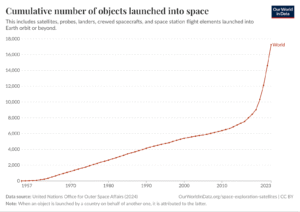
Figure 1: Cumulative number of objects launched into space from 1957 to 2023 [6]
Space technology is now at the dawn of a revolution. Companies like Varda Space are exploring how zero-gravity can aid in the manufacturing of pharmaceuticals, and Starlink is providing internet access to millions of people with coverage spanning nearly the entire planet [7,8]. Reusable rockets provide the critical cost reduction that will continue to fuel this innovation and lead to many new use-cases for space and quite possibly the expansion of the human race to other planets [9].
The Drawback Of Reusability
To understand the main drawback of reusability, some basic rocket science has to first be understood. Fundamentally, rockets are machines that turn chemical energy into kinetic energy to launch an object or person, often referred to as the payload, into space. The chemical energy is stored in liquid fuel. In addition to carrying fuel, rockets must also carry oxygen, given that there isn’t any in space and the fuel needs to react with oxygen to release its energy. The fuel and the oxygen are stored in separate tanks and are collectively referred to as propellant.
Because there aren’t places to stop and refuel on the way to orbit, rockets must carry all the propellant needed for their entire journey. They carry so much propellant that most of it is used not to lift the rocket’s cargo but instead to lift the propellant itself during the journey to high altitudes and velocities. To understand this, consider the following analogy.

Figure 2: A car with a massive fuel tank
Imagine a car that’s pulling a gas tank the size of a semi truck (see Figure 2). The car can travel quite far without refueling, but most of the work done by the car’s engine is used to tow the enormous gas tank and its contents. A much smaller amount is used to move the passengers and the car itself. It’s the same for a rocket. Having such a large gas tank is ridiculous for cars, but it’s essential for rockets due to the lack of gas stations in space.
Going back to the analogy, every bit of additional mass added to the car demands a relatively large amount of the fuel to be added to the tank to accommodate moving that mass. Adding additional fuel necessitates adding even more fuel to help drag its extra weight along, a concept so fundamental to rocketry that the equation which describes it is simply called “the rocket equation” [10]. Elon Musk stated that the additional hardware that SpaceX’s reusable Falcon 9 rocket uses to achieve reusability results in up to 30 percent less cargo capability than if Falcon 9 were single use only [11]. Despite this drawback, reusability is still well worth it.
Guidance, Navigation, and Control
Now that the motivation behind reusability has been understood, we can examine how exactly a reusable rocket works. The following is a high-level overview of the rocket landing process. The first part of a reusable rocket launch is indistinguishable from that of an expendable rocket. The booster, which makes up the majority of the rocket and is the reusable component of Falcon 9, spends about 5 minutes to go from a standstill on the launchpad to a speed 10 times faster than that of a bullet shot out of a gun, after which it releases its cargo in space [12].
After successfully completing its primary purpose, the rocket must somehow find a way to end its journey standing upright in one piece on the ground. To do this, reusable rockets use the earth’s thick atmosphere to their advantage. As the rocket falls to the ground, air resistance will remove most of its speed, converting the rocket’s kinetic energy into heat [13]. Because air resistance will do most of the work here, the rocket needs far less fuel for the landing than for the launch itself.
To remove its remaining velocity, the rocket relights its engines, using their thrust –powered by its remaining fuel– to slow to a stop right as it touches the ground [12]. During this phase, the engines are pointed downwards since the rocket is travelling down and in that orientation they produce thrust that pushes the rocket upwards. This rocket orientation is useful for more than just the final moments, however. Throughout the rocket’s descent, it also adds significant stability [14]. This is because rocket engines are heavy compared to the rest of the rocket, and a weight at one end similar to the weight near the front of a dart. A rocket that’s mostly empty of fuel travelling with its engines behind it would be like throwing a dart backwards. It’s aerodynamically unstable to have a heavy weight in the back and stable to have it in the front. An illustration of this is displayed in Figure 3.
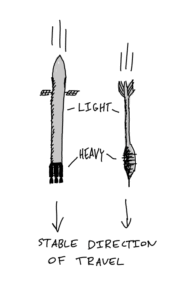
Figure 3: Rocket mass distribution compared to a dart
So far, we have a reasonable plan for reducing the rocket’s speed. However, we still need to consider how the rocket will accurately land at a target location as well as maintain orientation and properly time the relighting of its engines. This is where the field of Guide, Navigation, and Control (GNC) comes in. Navigation determines where the rocket is and how fast it’s moving,guidance helps plan a trajectory that the rocket can take to safely land at the landing site without smashing into the ground,and control is about actually executing that trajectory. Let’s take a closer look at each component of GNC.
Navigation
The first challenge the rocket must approach is the navigation component of GNC. Navigation refers to how the rocket knows its position, velocity, and orientation (commonly called “attitude” in the aerospace world). Interestingly, rockets measure their position practically the same way your phone does: through GPS and IMU data [15].
IMU stands for inertial measurement unit. Think of an IMU like a person being kidnapped in the trunk of a car. That person is unable to see, so they can’t directly observe how fast the car is moving or where it is. But if the car accelerates, brakes, or turns, the person feels it. An IMU uses a tiny piece of metal on the end of a spring instead of a person in a trunk. The spring contracts and stretches as the piece of metal is jostled around by the acceleration of the rocket, which the IMU can detect by measuring an electrical property called capacitance [16].
Even though we are used to using the Global Positioning System (GPS) to track our 2D position on the ground, GPS is actually capable of measuring position in all 3 dimensions. GPS relies on 31 satellites that use radio waves to broadcast their current time and position. Because GPS satellites are some distance away from a launched rocket, the satellite signals take time to reach the rocket. By comparing the time on the rocket with the time the signals from multiple satellites were sent, the rocket can determine the distance to each satellite and triangulate its own position [17]. In addition to GPS and IMU data, reusable rockets often use pressure sensors to get information on wind speed and altitude. As the altitude increases, the pressure drops and vice versa [15].
An important thing to realize is that all sensors are always wrong about the values they report. The question is just how wrong. A ruler, for example, is accurate only up to the smallest tick marks, and GPS is accurate to within a ballpark of about a meter [18]. GPS error comes from many sources, such as the distortion of radio signals sent from satellites when traveling through the atmosphere. Think of a straw appearing bent as it enters a glass of water. The water and the air are different densities, so they bend the light. The same thing happens with regions of the atmosphere that are at different densities and temperatures. See Figure 4.

Figure 4: GPS radio wave being refracted
By using data from multiple sources (i.e. GPS, IMUs, and pressure sensors), this error can be reduced. To do this, rockets commonly use a technique called a Kalman filter. A Kalman filter works by making a prediction about where the rocket will be in the future. It might use the assumption that the rocket isn’t going to suddenly move sideways, and it might also use data from the IMU (i.e. information about the rocket’s acceleration and rotation). Then it can have a better idea about how much to trust the data from another source, like GPS. If the position reported by GPS matches up well with the expected position, it can assume that the GPS error is low. The more the two estimates differ, the more the Kalman filter can skew its position estimate towards the initial prediction [19].
Guidance
The second problem is the Guidance component of GNC. This means calculating the trajectory that the rocket should follow in order to reach a safe landing. According to experts, this is the single most difficult part of landing a rocket [1].
SpaceX often lands their rockets on autonomously piloted platforms floating in the ocean (so-called “drone ships”). To give a sense of scale, these drone ships measure 160 feet wide by 230 feet long [20].
SpaceX understands that all the mechanisms from the flight computers running the GNC algorithms to the rocket engines themselves have to work together in perfect harmony to achieve a successful landing. They also understand that their drone ships are expensive, and they would like to avoid destroying them in the event of a failed landing.
So SpaceX makes sure the rocket is initially on a trajectory that will miss the drone ship entirely and safely fall into the ocean unless everything successfully works together to divert from this trajectory once it’s close to landing. If something goes wrong, the rocket likely won’t be able to navigate away from its default trajectory, thereby saving the drone ship [18].
Thus, the goal of guidance is to calculate a trajectory which will carry it away from its current path and onto one which ends with the rocket standing upright on the drone ship or landing pad. This is more complex than it might seem. The rocket must find a solution to this math problem, taking into account wind, its current position and velocity, its current propellant levels, and the limitations of its own hardware. If the rocket decides on a trajectory which requires too much fuel or requires that its movable fins rotate further than they’re able or makes any other mistake, it will fail to land [18].
On top of all these constraints, the rocket also must be able to identify this trajectory in time to execute it. This is a major concern when designing these algorithms. Even fractions of a second matter a lot here. For this reason, the rocket guides itself fully autonomously with zero human intervention. Even many purely mathematical techniques cannot run on a computer in such a way that it guarantees an answer fast enough time. The problem is that the number of steps required to solve an unknown equation cannot be determined beforehand, so despite the predictability of the computer itself, the total algorithm’s runtime cannot be guaranteed. So SpaceX and many others use an approach called convexification to approximate the problem in a way that allows for quick calculations and yet is still accurate enough to land the rocket on the landing pad [13,5].
To add some additional context, the rocket is gathering sensor data and doing calculations at a speed of tens or hundreds of times per second [21]. It does this because it must constantly reassess where it is and re-plan its desired trajectory due to unplanned disturbances such as those caused by wind or imperfections in the mechanics of the rocket. Doing otherwise would be like not touching the steering wheel at all after merging onto a freeway. You might continue driving straight for a decent amount of time, but without constant adjustments, the car would eventually veer off course due to imperfections in the car and its environment. The rocket must do the same thing, and it makes these adjustments many times per second.
Control
The third challenge is the Control component of GNC, which lies in the fact that the rocket must actually execute its plan to land. To accomplish this, the rocket must be equipped with certain hardware that can steer and accelerate it.
There are many ways to do this, but SpaceX’s Falcon 9 uses three main mechanisms (see Figure 5) [22]. The first is the rocket engines themselves. They are able to tilt to produce thrust in a slightly sideways direction, allowing the rocket to maneuver. The second is small thrusters near the top of the rocket that shoot jets of nitrogen gas sideways. These are relatively weak and allow the rocket to make fine adjustments. Lastly, there are the grid fins. These are also near the top of the rocket and consist of sheets of metal welded together in a grid pattern. The holes of the grid let air flow through, and by tilting the entire grid fins Falcon 9 can direct airflow and steer itself.

Figure 5: The mechanisms SpaceX’s Falcon 9 uses for control
Looking Forward
Without a doubt, the future of reusable rockets is SpaceX’s Starship. Although rockets like Falcon 9 are already quite impressive, Starship will be both fully reusable and significantly larger than Falcon 9. It’s nearly 100 feet taller than the Statue of Liberty, and it can carry 150 tons into orbit [23, 24]. That means a single Starship launch can accomplish almost as much as 7 Falcon 9 launches [24].
As Starship is perfected in the next few years, it will enable countless space projects, including launching Starlink V2 in the short term and Mars colonization efforts in the long term [25, 26]. A network of 30,000 Starlink V2 satellites will be able to send and receive radio waves directly to smartphones, eliminating both the need for cell towers and bad reception at the same time. Anywhere on the entire planet will have coverage [25]. Elon Musk believes Starship will also be the key to building a self-sustaining city on Mars. He stated that it will land humans on the surface of the planet within a decade and is confident that a city can be established in three.
In addition to SpaceX endeavors, companies like Varda Space are working on building manufacturing hubs in space [7]. Vast, Blue Origin, Axiom Space, and Lockheed Martin are pursuing private space stations [27]. AstroForge is pursuing asteroid mining, and total funding for space tech startups was $6 billion in 2024 [28]. Regardless of which technologies and projects pan out, it is clear that reusable rockets are powering a space revolution, and humanity is increasingly reaching for the stars.
Suggested Reading
https://www.geotab.com/blog/what-is-gps/
https://www.theoverview.org/p/lessons-i-learned-as-a-spacex-gnc
https://thekalmanfilter.com/kalman-filter-explained-simply/
Suggested Media
https://www.youtube.com/watch?v=Owji-ukVt9M
https://www.youtube.com/watch?v=wbSwFU6tY1c
https://www.youtube.com/watch?v=bAUVCn_jw5I
References
[1] X. Liu, “Fuel-optimal rocket landing with aerodynamic controls,” Journal Of Guidance, Control, And Dynamics, Jan. 2019. [Online]. Available: https://arc-aiaa-org.libproxy1.usc.edu/doi/pdf/10.2514/1.G003537
[2] J. Foust, “New contract unlikely to significantly reduce SLS costs,” SpaceNews, Oct. 2023. [Online]. Available: https://spacenews.com/new-contract-unlikely-to-significantly-reduce-sls-costs/
[3] J Foust, “Musk outlines plans to increase Starship launch rate and performance,” SpaceNews, Apr. 2024. [Online]. Available: https://spacenews.com/musk-outlines-plans-to-increase-starship-launch-rate-and-performance/
[4] S. Callsen, J. Wilken, S. Stappert, and M. Sippel, “Feasible options for point-to-point passenger transport with rocket propelled reusable launch vehicles,” Acta Astronautica, vol. 212, pp. 100–110, 2023. doi:10.1016/j.actaastro.2023.07.016. [Online]. Available: https://www.sciencedirect.com/science/article/pii/S0094576523003673
[5] R. Yang, “Rocket landing guidance based on linearization-free convexification,” Journal Of Guidance, Control, And Dynamics, Feb. 2024. [Online]. Available: https://arc-aiaa-org.libproxy2.usc.edu/doi/pdf/10.2514/1.G007706
[6] United Nations Office for Outer Space Affairs (UNOOSA), “Cumulative number of objects launched into space,” Our World In Data, Jan. 2024. [Online]. Available: https://ourworldindata.org/grapher/cumulative-number-of-objects-launched-into-outer-space?country=~OWID_WRL
[7] T. Cross, “Varda Space Industries advances space-based manufacturing and hypersonic testing,” SpaceExplored, Dec. 2024, [Online]. Available: https://spaceexplored.com/2024/12/23/varda-space-industries-advances-space-based-manufacturing-and-hypersonic-testing/
[8] A. Cuthbertson, “Starlink can now be used on the move ‘almost everywhere on earth’,” The Independent, May 2023. [Online]. Available: https://www.the-independent.com/tech/starlink-mobility-internet-spacex-elon-musk-b2344813.html
[9] H. Weitering, “How SpaceX’s Starship will help establish a mars base,” Space.com, Aug. 2019. [Online]. Available: https://www.space.com/spacex-starship-mars-transportation-plans.html
[10] E. Choueiri, “The efficient future of deep-space travel–electric rockets,” Scientific American, Feb. 2009. [Online]. Available: https://www.scientificamerican.com/article/the-efficient-future-of-deep-space/
[11] M. Belfiore, “Musk: SpaceX now has ‘all the pieces’ for truly reusable rockets,” Popular Mechanics, Sep. 2013. [Online]. Available: https://www.popularmechanics.com/space/rockets/a9504/musk-spacex-now-has-all-the-pieces-for-reusable-rockets-15985616/
[12] SpaceFlight Now, “Watch live: SpaceX Falcon 9 rocket launches 23 Starlink satellites from Vandenberg, California,” YouTube, Feb. 2024. [Online]. Available: https://www.youtube.com/watch?v=Phqt9sz0T3Q
[13] L. Blackmore, “Autonomous Precision Landing of Space Rockets,” The Bridge, Winter 2016. [Online]. Available: http://www.larsblackmore.com/nae_bridge_2016.pdf
[14] S. Nonoka et al., “Aerodynamic design considerations in vertical landing rocket vehicle,” AIAA/NAL-NASDA-ISAS 10th International Space Planes and Hypersonic Systems and Technologies Conference, Apr. 2001. [Online]. Available: https://arc-aiaa-org.libproxy1.usc.edu/doi/pdf/10.2514/6.2001-1898
[15] A. Botelho et al., “Design of the landing guidance for the retro‑propulsive vertical landing of a reusable rocket stage,” CEAS Space Journal, Feb. 2022. [Online]. Available: https://link.springer.com/content/pdf/10.1007/s12567-022-00423-6.pdf
[16] Z. Strout, “How does an IMU work?” SageMotion, Apr. 11, 2025. Available: https://www.sagemotion.com/blog/how-does-an-imu-work
[17] Federal Aviation Administration, “Satellite Navigation – GPS – How It Works,” Federal Aviation Administration, Available: https://www.faa.gov/about/office_org/headquarters_offices/ato/service_units/techops/navservices/gnss/gps/howitworks
[18] C. Satirapod et al. “GPS single point positioning with sa off: how accurate can we get?” ResearchGate, Oct. 2001. [Online]. Available: https://www.researchgate.net/profile/Jinling-Wang-8/publication/233660816_GPS_single_point_positioning_with_SA_off_How_accurate_can_we_get/links/0deec52c2164187a7a000000/GPS-single-point-positioning-with-SA-off-How-accurate-can-we-get.pdf
[19] T. Babb, “How a Kalman filter works, in pictures,” Bzarg, Aug. 2015. [Online]. Available: https://www.bzarg.com/p/how-a-kalman-filter-works-in-pictures/
[20] M. Huang, “Analysis of rocket modelling accuracy and capsule landing safety,” International Journal of Aeronautical and Space Sciences, Jan. 2022. [Online]. Available: https://link-springer-com.libproxy2.usc.edu/content/pdf/10.1007/s42405-021-00439-y.pdf
[21] P. Kurten, “Apollo experience report – guidance and control systems: lunar module abort guidance system,” NASA, Jul. 1975. [Online]. Available: https://ntrs.nasa.gov/api/citations/19750018954/downloads/19750018954.pdf
[22] T. Dodd, “How SpaceX lands the Falcon 9: Grid Fins, Thrusters and Engines!” YouTube, Jun. 2017. [Online] Available: https://www.youtube.com/watch?v=Qf5xElWwyQc
[23] C. Raypole, “How big is the SpaceX Starship mega-rocket? Photos show how tall it is,” Business Insider, Mar. 14, 2024. Available: https://www.businessinsider.com/how-big-is-spacex-starship-2023-4
[24] A. Law, “The definitive guide to Starship: Starship vs Falcon 9, what’s new and improved?” EverydayAstronaut, Nov. 6, 2020. Available: https://everydayastronaut.com/definitive-guide-to-starship/
[25] J. Rainbow, “SpaceX and T-Mobile partner for direct-to-cellphone satellite service,” SpaceNews, Aug. 25, 2022. Available: https://spacenews.com/spacex-and-t-mobile-partner-for-direct-to-cellphone-satellite-service/
[26] K. Grind, “Elon musk’s plan to put a million earthlings on mars in 20 years” New York Times, Jul. 12, 2024. Available: https://www.nytimes.com/2024/07/11/technology/elon-musk-spacex-mars.html
[27] D. Adler, “We’re entering the era of private space stations,” Astronomy, Nov. 6, 2024. Available: https://www.astronomy.com/space-exploration/were-entering-the-era-of-private-space-stations/
[28] C. Metinko, “Investors once again star gazing — space tech funding jumps,” Crunchbase News, Sep. 6, 2024. Available: https://news.crunchbase.com/venture/space-tech-startup-funding-jumps-2024/