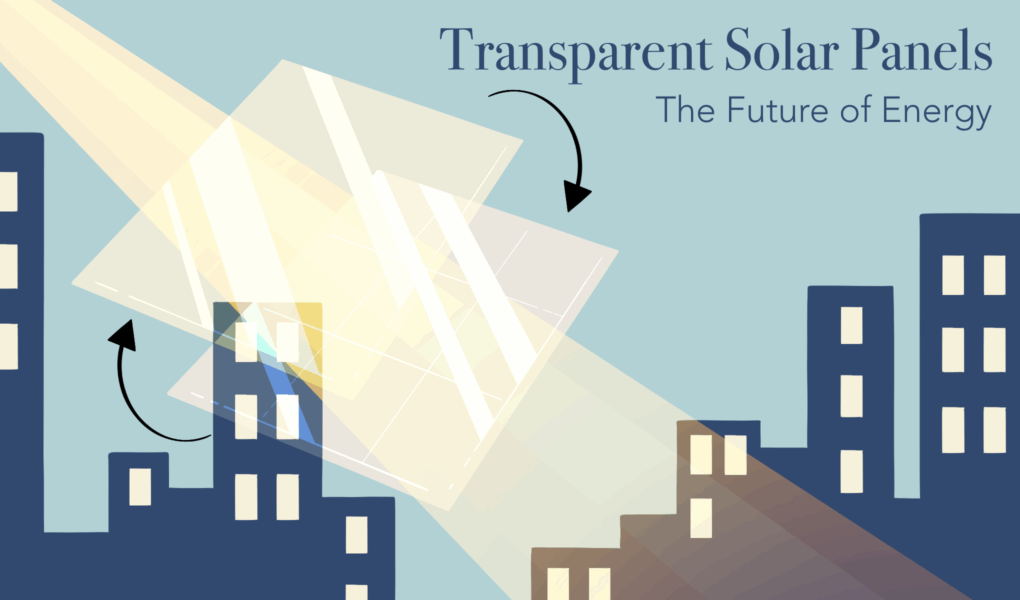
This paper will spread knowledge on transparent solar panels. Topics will range from how transparent solar panels work to the variety of different applications for which transparent solar panels will be used. It will also cover the practicalities of installing these panels in skyscrapers and global perception, showing how we can slowly implement this technology within cities worldwide. By the end of this analysis, you should be well-versed in current solar panel technology, research methodologies, and where this technology is projected to go in the future.
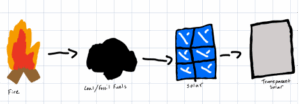
[Image done by author]
Introduction
Think of all the windows in the world, even just in Los Angeles, acres of unutilized space just waiting to be turned into a major clean energy source. Transparent solar panels represent the future of solar energy, with the ability to power the very cities they lay on. Traditional solar panels have done amazing things for us, allowing us to power towns and neighborhoods with little to no pollution. Transparent solar panels take this technology one giant step forward, filtering out visible light while collecting energy from the invisible. Their applications would stretch from building windows to the screens of our phones, giving us all the power we need while also helping to save the environment.
Old vs. New
Solar farms today are massive plots of land with raised solar panels facing in the direction of the sun. Most of today’s solar energy comes from solar farms, and while this may be a step in the right direction, solar farms have numerous negatives.
Solar farms occupy massive amounts of space in remote parts of the world; take the Xinjiang solar farm in China which is the largest farm to date and takes up 200,000 acres of land. Solar farms of this scale lead to the displacement of wildlife, despite one of the main reasons behind solar development being to protect the environment. On average, a solar farm will use 3.5 to 10 acres for each megawatt generated. As an example, a solar farm requires 500 acres of land to generate 50 megawatts [1]. Deserts and grasslands are the target environment for solar farms, but these environments have relatively fragile ecosystems, which means that a solar farm could be detrimental to biodiversity and soil health [1]. Additionally, high maintenance costs are required for these remote locations, in addition to large transportation infrastructure such as power lines that go on for miles to reach the nearest city. As a result, the price for energy increases with these added costs.
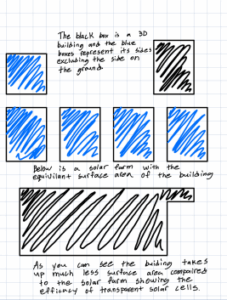
[Image done by author]
The production of these solar panels are also the source of great controversy involving human rights issues. In the Congo, the number one producer of cobalt, the majority of its materials are harnessed through artisanal mines. Artisanal miners hand-dig minerals in small mines that are unsupervised and not structurally sound [2]. These workers are often overworked and are continuously exposed to toxic materials and dust from pulverized rock. The system has put the safety of the workers at constant risk and keeps them there through extremely low pay, about 2 dollars a day.
With transparent solar panels, however, these issues fade from existence. Being installed in skyscrapers in already established cities, there will be no additional environmental repercussions, as seen with solar farms. Installation would be as simple as changing a window, and the environmental benefits would far exceed anything we see today in modern solar farms. Since the energy source would be located within the city, operating costs would be lower due to reduced maintenance requirements and the elimination of the need for extensive power line infrastructure. Additionally, with new materials being used in the production process such as silicon and “organic materials”, the need for cobalt would go down, hopefully putting an end to dangerous mining practices that put countless lives at risk.
How Do They Work?
While it’s clear that transparent solar panels are superior to traditional ones, they are still in the early stages of development. At first, it may seem like transparent solar panels are a counterintuitive idea because how could you absorb the sun’s energy yet allow the light to travel right through? This is because transparent solar panels are designed to absorb the areas of the solar spectrum, such as ultraviolet and infrared, that are invisible to the human eye, allowing light to pass while also harnessing energy.
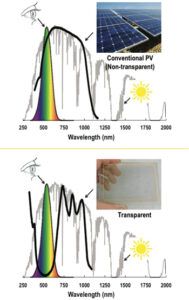 Figure [3]
The most common material used for this selective solar light process is transparent photovoltaic glass or TPV for short. Researchers found promising results when using wave-guided photoluminescence, which is when the TPV’s harnessed light is directed to the edges of the transparent panel where strips of solar cells, similar to traditional solar panels, have been placed and can convert the light into usable energy [4]. Researchers at Michigan State have been at the forefront of this technology, creating transparent solar panels with high levels of efficiency. They created a “new material” composed of organic molecules such as polypropylene (a rubber component) engineered specifically for the purpose of TPV’s [5]. This material can harness energy with complete transparency by letting visible light pass through while UV and infrared are absorbed. This same team also experimented with silver as an electrode due to its high conductivity and saw a 10.8% increase in efficiency over other electrodes such as zinc; however, it only had 48.5% transparency [5]. This back-and-forth between efficiency, transparency, and materials has been the main focus point in transparent solar panel research.
The most common material used for this selective solar light process is transparent photovoltaic glass or TPV for short. Researchers found promising results when using wave-guided photoluminescence, which is when the TPV’s harnessed light is directed to the edges of the transparent panel where strips of solar cells, similar to traditional solar panels, have been placed and can convert the light into usable energy [4]. Researchers at Michigan State have been at the forefront of this technology, creating transparent solar panels with high levels of efficiency. They created a “new material” composed of organic molecules such as polypropylene (a rubber component) engineered specifically for the purpose of TPV’s [5]. This material can harness energy with complete transparency by letting visible light pass through while UV and infrared are absorbed. This same team also experimented with silver as an electrode due to its high conductivity and saw a 10.8% increase in efficiency over other electrodes such as zinc; however, it only had 48.5% transparency [5]. This back-and-forth between efficiency, transparency, and materials has been the main focus point in transparent solar panel research.
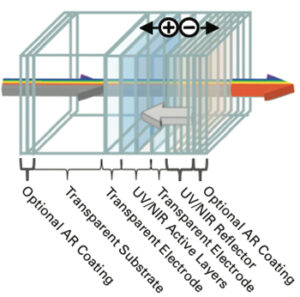
Figure [3]
A research team in South Korea is doing something considerably different, showing how much is yet to be uncovered in this field. This team’s method starts by inserting a thin layer of silicon, commonly used in computer hardware, between two transparent metal-oxide semiconductors. Through experimentation, they observed three main advantages to using silicon. First, it allowed for the utilization of longer-wavelength light, allowing it to absorb more forms of light on the solar spectrum. Second, it resulted in efficient photon collection. Third, it allowed for the faster transport of charged particles to the electrodes, which is when the particles connect with the sun’s energy and move toward an electrode, resulting in less energy loss [6]. With promising results through the use of silicon, the team is optimistic about implementing this technology in the real world.
Applications
While transparent solar panels have yet to become a global initiative, their applications can be endless once production methods are perfected. Apart from skyscrapers, these panels can be used for greenhouses, spacecraft, and any other object with a transparent surface. A research group at UCLA tested their own version of transparent solar panels for the purpose of a greenhouse and saw that a transparent solar cell made from organic material actually outperformed a traditional one with just glass [7]. This application has the potential to revolutionize the agricultural industry, giving farmers more productive crop yields and saving them money on energy costs.
Additionally, transparent solar cells show great promise in the aerospace field. They would be able to double as a window and power source, and spacecraft would also benefit from their light weight. This application would be suitable for one design specifically, which, instead of silicon, would use an extremely thin layer of tungsten diselenide films, which offer higher absorption rates while also being much lighter [8]. With the aerospace industry experiencing rapid growth in the 21st century, this technology will play a key role in shaping future spacecraft. The applications of these varying types of transparent solar cells not only give us a good idea of where these cells will be implemented but also the wide range of applications they hold. Anything that requires a clear layer of glass such as car windows, electronic screens, and even sunglasses all have the potential to generate electricity through transparent solar cells. With strong potential, a large factor influencing their success will be how seamlessly they can integrate into existing designs and infrastructure.
The Implementation Process
Researchers at MIT claim the integration of transparent solar panels can piggyback off of already established infrastructure, such as window replacement and cleaning services [3]. This “piggyback” method would make implementation easier and cheaper, making it a more viable option for large companies. This method would minimize disruption in urban areas while also making the transition process much more manageable.
The Future
The future is bright for transparent solar panels. With newly emerging technology every year, it’s likely we will start to see transparent solar panels make a breakthrough. This means a practical design method will be solidified, and a strong production method will be created on a global scale. The companies that seem to be making the most significant strides in this direction are Brite Solar, Onyx Solar, and Polysolar [11]. All these companies have a strong emphasis on solar panels and have current products on the market.
Based in Greece, Brite Solar has been experimenting with efficiency and transparent levels, working to make the clearest and most efficient panels on the market. Onyx Solar, however, is taking a more niche approach to the market. The Spanish-based company specializes in making skylights, canopies, and facades, which really focus on making the panels clear and even flexible. In the UK, Polysolar is mainly working on building integrated photovoltaics which are specifically designed to fit into skyscrapers and urban areas, replacing normal windows [11]. With companies like these and so many more making strides in the right direction, the future of transparent solar panels is bright. It now becomes a matter of getting the word out there and convincing people that Transparent solar panels are a far better option than anything else on the market.
Challenges Ahead
While transparent solar panels have the potential to take over the world, there are several challenges that must be resolved. First and most telling is the different ways they are currently being produced. Because much of this technology is still in a “research phase,” research teams have come up with multiple different methods of construction. For example the Michigan State team using an organic material while the Korean research team using silicon. From panel efficiency to the core materials used, transparent solar panels come in a large variety, which makes production more difficult.
Additionally, transparent solar panels currently run at much lower efficiency levels, around 5-10%, while traditional ones have about 20-25% efficiency [8]. Having lower efficacy levels makes them much less competitive. Comparatively, convincing the public and large corporations to make the switch based on this fact alone becomes significantly more challenging. This issue also starts to become a matter of finances as well. Because transparent solar panels are not able to save people as much money as would traditional ones, it makes no financial sense for people to make the switch. With financial viability typically being the most compelling factor, it is much harder for transparent solar panels to outcompete traditional ones despite their environmental benefits.
Final Thoughts
Transparent solar panels have the potential to change our world for the better. They are the clear winner when it comes to being the most environmentally friendly over other renewable options, especially fossil fuels. Even the production process is cleaner than most other renewable energy sources, further emphasizing how good this technology is for the environment and ourselves.
That being said, there are two main obstacles that stand in the way of transparent solar panels. First is that this tech is still very new and in the research and testing phase of development, making it hard to say what method will be ready for global production. Second, is making the shift from a majority of fossil fuels to a majority of renewable energy. This will take a lot of time, and both people and the economy will cause this to happen over a long period of time. Just like any new product, it will take time for people to catch on and for major companies to make the switch. So, while the upward progression will be long and slow, it will undoubtedly move us into a future where transparent solar panels will be a major contributor to global energy.
For Further Reading Links
- https://earth.org/the-growth-of-renewable-energy-what-does-the-future-hold/
- https://www.un.org/en/climatechange/raising-ambition/renewable-energy
- https://energy.mit.edu/research/future-solar-energy/
- https://www.nrel.gov/news/program/2022/building-a-solar-powered-future.html
Multi-Media Links
- https://www.youtube.com/watch?v=qMhdpWMDp04&t=2s
- https://www.youtube.com/watch?v=EAU5D8hqIUI
- https://www.youtube.com/watch?v=N-yALPEpV4w
- https://www.youtube.com/watch?v=E39neWnw9AA
References:
[1] Environmental Protection Agency. “Environmental Impacts of Solar Power.” Union of Concerned Scientists, www.ucsusa.org/resources/environmental-impacts-solar-power Accessed 26 Jan. 2025.
[2] A. Murray. “Cobalt Mining: The Dark Side of the Energy Transition.” Earth.Org, 4 Mar. 2024, earth.org/cobalt-mining/ Accessed 7 Feb. 2025.
[3] N. Stauffer. “Transparent Solar Cells.” MIT Energy Initiative, 29 Mar. 2024, energy.mit.edu/news/transparent-solar-cells/. Accessed 19 Jan. 2025.
[4] Yang, Chenchen. “Ultraviolet and Near-Infrared Dual Band Selective-Harvesting Transparent Luminescent Solar Concentrators.” arXiv.Org, 20 Sept. 2020, arxiv.org/abs/2009.09542 Accessed 19 Jan. 2025.
[5] Y. Li, X. Guo, Z. Peng, B. Qu, H. Yan, H. Ade, M. Zhang, and S. Forrest. “Transparent Solar Panels for Windows Hit Record 8 Percent Efficiency.” ScienceDaily, ScienceDaily, 18 Aug. 2020, www.sciencedaily.com/releases/2020/08/200817150449.htm Accessed 19 Jan. 2025.
[6] K. Joondong. “‘Transparent Solar Cells’ Can Take Us towards a New Era of Personalized Energy.” AltEnergyMag, www.altenergymag.com/story/2020/11/transparent-solar-cells-can-take-us-towards-a-new-era-of-personalized-energy/34023/. Accessed 19 Jan. 2025.
[7] L. Zongqi. “UCLA Engineers Design Solar Roofs to Harvest Energy for Greenhouses.” UCLA Samueli School Of Engineering, samueli.ucla.edu/ucla-engineers-design-solar-roofs-to-harvest-energy-for-greenhouses/ . Accessed 28 Jan. 2025.
[8] L. AI. “Transparent Solar Cells Achieve Efficiency Boost.” IO, 29 Aug. 2024, innovationorigins.com/en/transparent-solar-cells-achieve-efficiency-boost/. Accessed 28 Jan. 2025.
[9] M. Abeni. “Transparent Solar Panels: An Expert Guide [UK, 2025].” Transparent Solar Panels: An Expert Guide, 2 Jan. 2025, www.sunsave.energy/solar-panels-advice/solar-technology/transparent?utm_source. Accessed 28 Jan. 2025.
[10] S. Shoemaker. US Government EPA. “Sources of Greenhouse Gas Emissions.” EPA, Environmental Protection Agency, www.epa.gov/ghgemissions/sources-greenhouse-gas-emissions. Accessed 29 Jan. 2025.
[11] S. Lozanova. “Transparent Solar Panels: The Future of Clean Energy?” GreenLancer, GreenLancer, 13 Dec. 2024, www.greenlancer.com/post/transparent-solar-panels. Accessed 29 Jan. 2025
[12] A. Deutsch. “Solar Energy Shines in Global Survey with 68% Support | Reuters.” Reuters, 15 Sept. 2023, www.reuters.com/sustainability/climate-energy/global-survey-shows-two-thirds-population-favours-solar-power-2023-09-15/. Accessed 29 Jan. 2025
[13] S. Ellerbeck. “IEA: More Than a Third of the World’s Electricity Will Come from Renewables in 2025.” World Economic Forum, www.weforum.org/stories/2023/03/electricity-generation-renewables-power-iea/. Accessed 7 Feb. 2025.
[14] M. Vinod, P. Jain, and E. Prasad. “Transparent Solar Cells Market Share, Trends: Growth Forecast – 2031.” Allied Market Research, www.alliedmarketresearch.com/transparent-solar-cells-market-A53571#:~:text=As%20p er%20CXO%20Perspective%2C%20the,significantly%20impact%20the%20market’s%20development. Accessed 29 Jan. 2025.