Though it might not look like it at first, bowling is a sport that combines the application of physics principles, critical thinking, and skillful utilization of techniques. As an ever-growing spectator sport in the United States, it is one of the most popular activities for people of all skill levels and backgrounds throughout the world. From the material composition and design of the bowling ball to the motion of the ball on the lane, almost every aspect of the game has science and engineering embedded in it. This article focuses on the physics and material science behind the sport of bowling, as well as the hidden benefits of bowling for all age ranges; all things that, with a firm understanding, can help one become a better bowler.
Introduction
Have you ever wondered how professional bowlers are able to consistently hit pins in the correct location? Or how Pete Weber, a famous bowling legend, can ride the ball along the gutter while still managing to curve it to get a strike? All the while, you consider yourself lucky if you manage to keep the ball in a straight line? Even though years of focused practice are necessary to achieve these amazing achievements, you also need a thorough understanding of physics, material science, and lane conditions is also crucial. Every element of the game, from the friction between the ball and the lane to the bowler’s grip and release of the ball, is based on core scientific principles. Rotational motion, energy transfer, and surface contacts are all important factors in how the ball goes down the lane and knocks down pins. Whether you are an avid bowler hoping to improve your score or a curious observer hoping to learn more about the game, understanding the underlying science behind the sport can enhance your enjoyment of the game and help improve your technique.

Figure 1: Former Professional Bowler, Pete Weber [1].
Origins of Bowling
Bowling traces its origins back to ancient civilizations, evolving over thousands of years into the game we know today. The earliest known form of bowling dates back to ancient Egypt, with players rolling a stone ball through an archway to hit smaller stone pieces [2]. The creation of the bowling pin emerged in ancient Germany; however, its intended use was for religious ceremonies, with the rolling of the stone against the pins symbolizing the cleansing of sins. In this era, the ideal number of pins was established to be nine by Martin Luther, for its balance of entertainment and challenge. Jumping forward to the 20th century, bowling spread to North America with English settlers bringing their own unique variation to the game, one of the most prominent being the shift from nine to ten pins [3].
The introduction of indoor lanes began later in the 20th century across the United States, marking a turning point for the sport. Around this time, the United States Bowling Congress was formed, establishing nationally set rules for the game and placing guidelines for competitive play, allowing bowling to become the beloved recreational pastime and popular spectator sport that it is today. Consequently, alley locations and varying ball geometries were meticulously improved upon to enhance players’ experience and create a challenging game environment. Throughout the evolution of bowling over the years, research has allowed itself to improve the game and its players; from ball motion and speed to the material science behind bowling balls, understanding the scientific phenomena behind bowling can lead you to becoming a better bowler and learn the secret to hitting a strike.
Ball Release: The Importance of the Walk-up
Arguably, one of the most important aspects of bowling is the player’s approach before releasing the ball. The action of bowling consists of a multi-step process, where, ideally, the player utilizes 4 physical steps for their shot as they move toward the foul line, known as the 4-step approach. In the first step, the bowler begins the “run-up phase,” where they begin moving toward the lane. During this phase, the bowler pulls back their arm holding the ball, and around the third to last heel touch before release, the bowling ball reaches the top of the backswing, where the ball has the highest potential energy (i.e., the higher the ball is held, the more potential energy it has). From this position, the ball then travels down as the bowler swings the ball, transforming all the potential energy into kinetic energy. As the swing occurs, the bowler then pushes their dominant foot into the final heel touch, which then allows their non-dominant foot to slide forward just before the foul line to what is called the front foot slide [4]. During this final fourth step, the bowler finally releases the ball, generating the force that pushes the ball forward with a velocity.

Figure 2: The Four Step Approach [5].
The ability to control ball speed is primarily dependent on the acceleration of the bowler’s arm during the swing. This acceleration is influenced by muscle coordination, wrist action, and timing throughout this movement. A study on biomechanics in bowling suggests that an optimal balance between force application and fluid motion is necessary to achieve consistent results [6]. For example, pulling the ball back higher during the backswing increases potential energy, which, when combined with a smooth and powerful forward motion, translates into greater speed. However, raw speed alone is not always the goal; precise control of the ball is equally important. Accelerating the arm too quickly without proper wrist alignment or timing can disrupt the ball’s trajectory, leading to less accurate throws. Conversely, a well-timed acceleration from steps three through five of the approach can generate not just speed, but also a controlled, powerful release that maximizes pin action. This means that, as the player, the main goal in perfecting this process is consistently controlling the speed that you throw the ball. Mastering this interplay between speed and control allows bowlers to maintain consistency across multiple throws, a crucial factor in competitive play.
Faster Ball, Better Score
So now you know what factors are in play to control the ball’s speed—but why does it matter? A field study analyzing the techniques of the Danish national bowling team found a positive correlation between ball release velocity and a bowler’s average score [4]. This suggests that, to an extent, faster deliveries contribute to improved performance. However, does this mean that simply throwing the ball as hard as possible will guarantee a strike? Not necessarily. While higher speeds can enhance pin action by increasing kinetic energy transfer upon impact, accuracy and the angle of entry to the pins remain crucial for optimal pin carry [7]. The ball should enter the space between the pins so that the pins will knock into each other in a cascading effect. If the speed is too high without proper alignment, the ball may deflect off target, leading to splits or missed pins. Conversely, if the ball is too slow, there may not be enough force to drive through the pins effectively.
Additionally, the aforementioned study involved professional bowlers, meaning that their success was not solely due to ball speed but also a combination of other factors, such as revolution rate, axis rotation, and lane conditions. Research has shown that professional bowlers optimize speed in conjunction with rotational motion (rev rate) to create an effective hook, which increases strike probability by enhancing pin scatter [8]. One such way to produce a greater revolution rate involves releasing the ball with spin, rather than simply tossing the ball. The spin exhibited on the ball will then eventually be transferred over to the pins, which will also start to spin, leading to a higher probability of knocking them down. However, with such a strategy, it is necessary to mind the desired trajectory of the ball. Therefore, mastering speed and control involves balancing velocity with accuracy, rotation, and lane adaptability.
The Physics Behind Ball Motion
After completing the walk-up phase and releasing the ball, the next crucial aspect behind the science of bowling is when the ball makes its initial contact with the lane. The primary force that affects the motion of the bowling ball is friction, which is defined as a resistive force that always opposes the direction of motion [9]. This force, along with others, acts on various points of the ball and comes into play the moment the ball contacts the lane, as illustrated in Figure 3.

Figure 3: Diagram of the main forces acting upon a bowling ball moving in the direction of velocity, v⃑.
Here, the ball has a force due to its weight (W) exerted downward, a friction force (F𝘧) at the point of contact between the ball and the lane opposing the ball’s motion (in this case the ball travels to the right so the friction force is pointing to the left), and a normal force (F𝘕) acting up from the surface of the lane onto the ball. In physics, the normal force is the reactive force that is exerted back to an object from the surface it sits upon. In this case, the lane is exerting an equal force onto the ball as the ball exerts onto it. As seen in Figure 3, unlike the rest of the forces, the friction force is off-center from the ball’s center of mass. This creates rotation of the ball in a clockwise direction (on account of the ball moving to the right in this case), which is what makes a bowling ball roll as it travels down the lane.
Sliding and Rolling
In bowling, the motion of the ball down the lane involves both rolling and slipping, two fundamental concepts in physics that describe how an object moves in relation to a surface. Rolling is the motion of an object that rotates around an axis while moving along a surface without sliding, whereas slipping happens when there is relative motion between the object and the surface, leading to a loss of traction and energy. When a bowler releases the ball, it does not instantly begin to roll; instead, it slides across the lane while rotating. Because the ball’s point of contact with the lane is not traveling at the same speed as the center of mass, this phase—known as slipping—occurs. This difference is lessened by the friction between the ball and the lane, which progressively puts the ball into a pure rolling state where its contact point briefly comes to rest in relation to the lane [10]. This transition from slipping to rolling is crucial in determining how effectively a bowler can control their shot. If the ball continues to slip too long, it won’t develop the ideal rotational energy needed to drive through the pins effectively, often resulting in a weak hit or missed pocket. On the other hand, if the ball starts rolling too soon, it may lose momentum before impact, limiting its pin-carrying potential.
In professional bowling, bowlers are not always playing in the same conditions. Each bowling alley and even each lane itself has a thin layer of oil placed upon it in different geometries, which is what is known as the lane’s oil pattern. This oil pattern can span anywhere from 30 to 50 feet, with varying amounts of oil in each spot based on the pattern. The lane’s oil pattern plays a significant role in this process of rolling and slipping. In the heavily oiled portion of the lane, friction is minimized, allowing the ball to maintain its initial slip longer. However, as the ball moves toward the drier section near the pins, friction increases, helping the ball transition into a rolling motion.
Although not visually apparent, lane patterns can be found simply by asking the technicians of the respective alley. This aspect of the bowling lane allows for the ball to move uniquely as it approaches the pins and creates a trajectory that can result in irregular falling of pins [11]. Even without a science background, professional bowlers have subconscious knowledge of the ball’s reaction on the lane. This is both an art and a science that most believe is necessary for maximizing the production of a strike [6]. Understanding of the ball’s movement down the entire lane can then lead to interesting manipulation of its path.
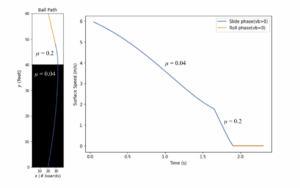
Figure 4: Location of the ball’s path on the lane (left) corresponding to its surface speed over time (right), where here, the Greek symbol represents the coefficient of friction for that respective part of the lane [10].
The Art of the Hook
If you were to watch a competitive bowling tournament, one of the main observations you might take away is that almost every single professional curves their shot in order to hit the pins. In bowling terminology, this curving of the ball is what is known as a hook. Due to the effects of friction, as mentioned beforehand, the ball undergoes a quick transition between sliding and rolling. This shift is particularly important for bowlers who rely on a hook, as the ball needs to be in a rolling state before it can fully grip the lane and curve toward the pins. Typically, the more oiled portion of a lane is toward the side where the bowler releases the ball, and bowling-alley technicians avoid oiling the area directly in front of the pins [7]. If a ball continues to slip too long, it may not hook effectively, while a ball that begins rolling too soon may lose energy before reaching the pins, reducing its striking power.
The moment of inertia is one of the many significant parameters that also affect the rotation of the ball during motion. In physics, what is known as inertial effects come into play during the process of the ball transitioning to the rolling phase. The moment of inertia is the measurement of the rotational inertia of a body, or how much an object resists changes while in rotational motion [13]. It is determined by both the mass of the object and how that mass is distributed relative to the axis of rotation. For example, a bowling ball with more mass concentrated near its outer surface has a higher moment of inertia compared to one with more mass concentrated near its center. This distribution affects how easily the ball can be spun. In combination with friction, the moment of inertia of the ball creates an angular momentum force which is what truly causes the ball to deviate from its initial path [13].

Figure 5: Bowling ball hook shots at different release angles [14].
Up until the ball reaches the edge of the gutter, it continues to skid while gradually gaining more rotational control due to the frictional forces acting on its surface. However, once the ball transitions from sliding to rolling, the stored angular momentum and rotational energy take full effect. The ball’s axis of rotation, initially tilted due to the bowler’s release, causes it to experience a torque (a twisting force that causes rotation) that shifts its trajectory inward [11]. This phenomenon, often referred to as “the hook phase,” occurs because the angular velocity and frictional torque combine to generate a curved motion, rather than allowing the ball to continue in a straight line.
The magnitude of the hook depends on factors such as the ball’s coverstock (surface material), core design, lane oil pattern, and the amount of spin imparted by the bowler when they twist the ball. A ball with a higher moment of inertia will resist changes in its rotational state longer, leading to a more gradual hook, while a ball with a lower moment of inertia will transition more aggressively. This controlled deviation is what allows skilled bowlers to consistently guide the ball into the pocket—the ideal impact zone for maximizing pin action and strike potential.
Hitting The Sweet Spot
In order to maximize your chance of getting a strike, you want to aim for the pocket. The “pocket” in bowling is the space between the pins. The angle that the ball enters the pocket is called the pocket angle. As shown in Figure 6, due to the triangular position in which the pins are set up, hitting the closer pockets of the 1-3 pins allows for more pins to get knocked over in a chain reaction [6]. Hitting these pockets is much easier when the ball enters from an angle because hitting the pins along a straight path results in less movement. The variable friction across the lane is the primary factor that enables a ball to hook. That is why bowling lanes are engineered so that the friction increases drastically as the ball reaches the pins. If the lane has a constant low friction spanning across its entirety, then the ball would not deflect enough to result in a high pocket angle. Thus, with high friction, the ball will roll too early and will deflect, resulting in too high of a pocket angle [13].

Figure 6: Overhead view of pins showing location of the pockets [15].
The speed of the ball is also crucial for maximizing your chance at hitting a strike. Higher velocity provides more force upon impact, and this extra force is essential for knocking down more pins. When a pin is struck, it applies force to the ones behind it, maximizing pinfall by creating a domino effect. Due to the “necked” geometry of the pin, the center of mass is located closer to the bottom of the pin, and when a force is placed upon a section of the pin above or below this center of mass, the pin tilts. Once the pin tilts enough to reach an unstable position, it falls over. The minimum amount of potential energy required to tip the pin over is the energy needed to move it into an unstable position where it can no longer remain upright [7].
The Anatomy of a Bowling Ball
Physics isn’t the only science that can improve your bowling game—materials science also plays a crucial role. The smooth, hefty spheres we see today weren’t always like this, but as materials and design have advanced, they have evolved from basic stone balls used in Ancient Egypt to be sophisticated devices designed for accuracy and efficiency. The three primary components of contemporary bowling balls are the core, coverstock, and intermediate layers. The core is the inner material that affects the weight distribution and rotation of the ball. The coverstock is the shell on the outside of the ball that has direct contact with the lane, influencing grip, friction, and potential to hook. Finally, the intermediate layers (if present) act as a bridge between the core and coverstock. The way a bowling ball interacts with the lane has changed dramatically as its materials have evolved from wood to rubber to polyester resin. This paved the way for the use of plastic, and finally, when polymers were introduced, the contemporary reactive resin [2]. The interior core design has also evolved, which affects the friction that the ball experiences, impacting elements like spin, hook potential, and overall control, in addition to the external shell [16].
To influence friction, modern bowling balls are made with a coverstock, or outer shell, that varies in texture and porosity (the amount of empty space or gaps in a material). The ball’s lane grip is influenced by the surface’s roughness, particularly in drier regions with increased friction. A smoother ball, such as one with a polished coverstock, slides further down the lane before rolling because it encounters less friction. On the other hand, a ball with a rougher surface—like one that is sanded down or matted—gaps the lane sooner, which increases its sensitivity to friction and enables it to hook sooner [2].

Figure 8: Cross-section of a bowling ball. Adapted From [17]
Another important element influencing a ball’s performance is oil absorption. Reactive resin coverstocks, which are designed to absorb oil at different rates, are used in the majority of contemporary bowling balls [2]. When a ball enters the drier section of the lane, higher oil absorption rates enable it to cut through the oil pattern of the lane more efficiently, increasing friction. Competitive bowlers frequently choose reactive resin balls because of the higher hook potential that results from this increased friction. On the other hand, urethane and plastic coverstocks skid more since they absorb less or no oil [11]. These effects are so integral to the sport of bowling that the United States Bowling Congress (USBC), the national governing body for the sport of bowling, has placed specifications for surface roughness and oil absorption rate of bowling balls [16].
Conclusion
From those who play just for fun to competitive athletes, bowling is still a popular sport that appeals to individuals of all ages. Families, friends, and leagues all over the world love it not only for its accessibility but also for he social aspects, with more than 45 million people participating annually in today’s day and age [3]. Bowling is not only a fun game, but just like any sport, it also has several health advantages, which make it an excellent way to stay active, especially as people get older.
Bowling offers a low-impact type of exercise, which is one of its main benefits. As research has shown, traditional sports, such as soccer and basketball, do not seem to promote lifelong physical activity [18]. As people age, they become physically inactive, and for this reason, bowling is a physical activity that should be promoted. So, if you want to try a physical activity, give bowling a shot. Whether you are out with your friends bowling or simply an observer of professional games, understanding the science behind the sport can improve your knowledge of the game and get you on the way to hitting the perfect strike.
Suggested Readings:
- An Interview with Pete Weber, By Rob Mautner. Available: https://www.bowlingthismonth.com/bowling-tips/an-interview-with-pete-weber/
- Easybowling: a small bowling machine based on virtual simulation, By Zhigeng Pan et al. Available: http://www.cad.zju.edu.cn/home/hj/03/VrBowlingMachine.pdf
- Advanced Material Engineering and Nanotechnology for Improving Sports Performance and Equipment, By Mohammed Shalaby and Mohamed Saad. Available: https://www.researchgate.net/profile/Mohammed-Shalaby-7/publication/341670625_Advanced_Material_Engineering_and_Nanotechnology_for_Improving_Sports_Performance_and_Equipment/links/5ed0aff945851529451b7689/Advanced-Material-Engineering-and-Nanotechnology-for-Improving-Sports-Performance-and-Equipment.pdf
Suggested Multimedia Applications:
- The Bowlers Journal Podcast. Available: https://youtu.be/g-dk0egmrFs
- 2012 Bowling’s 69th U.S. Open Stepladder Finals – Who Do You Think You Are? I am! Available: https://www.youtube.com/watch?v=iJ6a1hPz-K0
- Pool’s Dr. Dave Discusses BOWLING PHYSICS, TECHNOLOGY, and STRATEGY with Neil deGrasse Tyson. Available: https://www.youtube.com/watch?v=bYTWlNV9J5o
References
[1] Professional Bowlers Association, https://www.pba.com/ (accessed Feb. 8, 2025). Available: https://www.pba.com/pba-tour/pba50-tour
[2] L. Wolf, “What’s That Stuff? Knocking down pins and getting STRIKES with polymer science and surface chemistry,” Chemical and Engineering News Archive, vol. 86, no. 27, pp. 31, Jul. 7, 2008. Available: https://pubs-acs-org.libproxy1.usc.edu/doi/pdf/10.1021/cen-v086n027.p031
[3] USBC, United States Bowling Congress, “History of bowling,” BOWL.com, (accessed Feb. 8, 2025). Available: https://bowl.com/about-us/history-of-bowling
[4] B. E. Seiferheld, J. Frost, T. B. Østergaard, M. S. Krog, K. K. Klitgaard, and M. de Zee, “Full-Body Kinematics and Vertical Ground Reaction Forces in Elite Ten-Pin Bowling: A Field Study,” Sensors (Basel, Switzerland), vol. 23, no. 19, pp. 8284-, 2023, doi: 10.3390/s23198284. Available: https://www.proquest.com/docview/2876603355?pq-origsite=gscholar&fromopenview=true&sourcetype=Scholarly%20Journals
[5] “The approach,” BOWL.com, https://bowl.com/welcome/the-approach-4840c7151c5dc3884afbeb8041beac5a (accessed Feb. 8, 2025). Available: https://bowl.com/welcome/the-approach-4840c7151c5dc3884afbeb8041beac5a
[6] G. Allen and D. Ritger, “The Complete Guide to Bowling Strikes,” Tempe Publishers, https://www.amazon.com/Complete-Guide-Bowling-Principles-Encyclopedia/dp/B000BOODBM (accessed Jan. 24, 2025). Available: http://www.ncausbca.org/bowlmag/archives/guru–199102.pdf
[7] T. Burgess, “The Physics of Bowling,” The Physics teacher, vol. 34, no. 5, pp. 316–34:5<316, 1996, doi: 10.1119/1.2344456. Available: https://pubs-aip-org.libproxy2.usc.edu/aapt/pte/article/34/5/316/463274/The-physics-of-bowling
[8] S. A. Feros, W. B. Young, and B. J. O’Brien, “Quantifying cricket fast-bowling skill,” International journal of sports physiology and performance, vol. 13, no. 7, pp. 830–838, 2018, doi: 10.1123/ijspp.2017-0169. Available: https://research-ebsco-com.libproxy1.usc.edu/c/ubwwhd/viewer/pdf/diotdqjtxv?route=details
[9] E.W. Weisstein. (2007). Friction [Online]. Available: http://scienceworld.wolfram.com/physics/Friction.html
[10] S. Ji, S. Yang, W. Dominguez, and C. Bester, “Using Physics Simulations to Find Targeting Strategies in Competitive Bowling,” arXiv.org, 2022. Available: https://arxiv.org/pdf/2210.06753
[11] A. Z. Ahmad Zahudi, J. Usman, and N. A. Abu Osman, “Exploring the impact of bowling ball properties and performance through the use of technology: An analysis of bowling ball motion,” Proceedings of the Institution of Mechanical Engineers. Part P, Journal of sports engineering and technology, 2024, doi: 10.1177/17543371241260099. Available: https://journals-sagepub-com.libproxy1.usc.edu/doi/abs/10.1177/17543371241260099
[12] P. Davidovits, Physics in biology and medicine, Fourth edition. London: Elsevier/Academic Press, 2013. Available: https://www.sciencedirect.com/topics/mathematics/moment-of-inertia
[13] C. Frohlich, “What makes bowling balls hook?,” American journal of physics, vol. 72, no. 9, pp. 1170–1177, 2004, doi: 10.1119/1.1767099. Available: https://pubs-aip-org.libproxy1.usc.edu/aapt/ajp/article/72/9/1170/532613/What-makes-bowling-balls-hook
[14] wikiHow, “How to curve a bowling ball: 13 steps (with pictures),” wikiHow, https://www.wikihow.com/Curve-a-Bowling-Ball (accessed Feb. 8, 2025). Available: https://www.wikihow.com/Curve-a-Bowling-Ball
[15] K. Kuhar et al., “Bowling pin numbers,” Industrial Outpost – The Official News Source of PSC, https://www.industrialoutpost.com/oil-bowlings-invisible-superhero/bowling-pin-numbers/ (accessed Feb. 8, 2025). Available: https://www.industrialoutpost.com/oil-bowlings-invisible-superhero/bowling-pin-numbers/
[16] K. King, N. C. Perkins, H. Churchill, R. McGinnis, R. Doss, and R. Hickland, “Bowling ball dynamics revealed by miniature wireless MEMS inertial measurement unit,” Sports engineering, vol. 13, no. 2, pp. 95–104, 2011, doi: 10.1007/s12283-010-0054-z. Available: https://link-springer-com.libproxy2.usc.edu/article/10.1007/s12283-010-0054-z
[17] “How a bowling ball is made,” BOWL.com, https://bowl.com/welcome/how-a-bowling-ball-is-made (accessed Feb. 8, 2025). Available: https://bowl.com/welcome/how-a-bowling-ball-is-made
[18] T. T. Pritchard and S. J. McCollum, “Bowling for a Lifetime Using Sport Education,” Journal of physical education, recreation & dance, vol. 79, no. 3, pp. 17–23, 2008, doi: 10.1080/07303084.2008.10598144. Available: https://www.tandfonline.com/doi/epdf/10.1080/07303084.2008.10598144?needAccess=true